Selling your car to a stranger in San Diego County without getting scammed
To sell a car privately in San Diego County without being taken, confirm the payment with the bank that issued it before you sign the title, meet in a lighted public place, and file the Notice of Transfer and Release of Liability within 5 days of the sale. California's Attorney General and its Department of Financial Protection and Innovation (DFPI) keep describing the same few tricks: a check for more than the price, an app transfer that later disappears, an escrow site the buyer insists on. Below are those tricks, what San Diego County agencies say about meeting a buyer, and the order for the handover.
Sources re-checked .
Short answer
Confirm the payment with the bank that issued it, using a phone number you looked up yourself, before you sign the title. Meet in a lighted public place, never read a texted code to a buyer, check your insurance before a test drive, and file the Notice of Transfer and Release of Liability within 5 days.
DFPI: tips to avoid peer-2-peer payment scams; San Diego County District Attorney: marketplace scams alert (PDF)
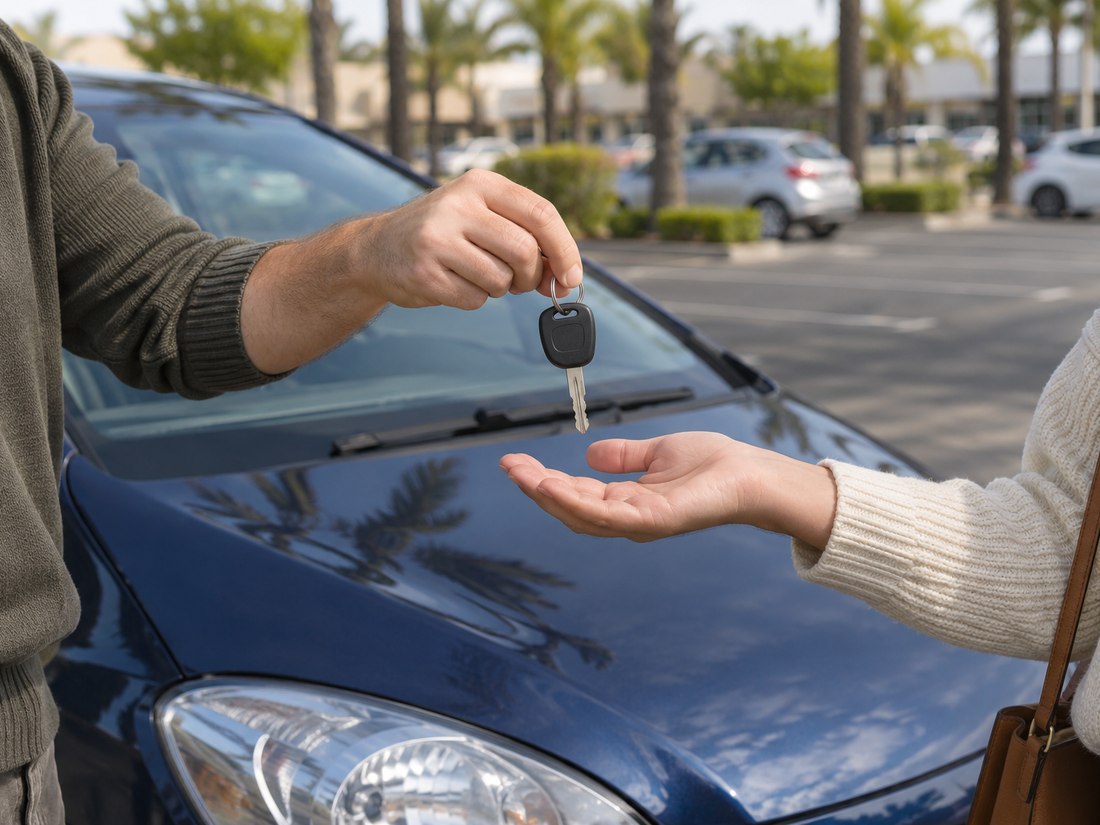
Four payment tricks aimed at people selling cars
The Attorney General's page on online purchases describes the first. A buyer sends a money order or check for more than the asking price and asks you to return the difference. Your bank accepts the deposit at first, then finds the fraud and takes back the whole amount, so the buyer keeps the car and the refund you sent.
Payment apps have their own version. The DFPI's July 2026 guide to peer-to-peer scams says fraudsters attach stolen credit cards to an app, pose as buyers of costly items such as vehicles, and "once the seller ships the goods, the payment is invalidated." It also says never to refund money someone claims they sent by mistake.
An escrow offer is the third. The DFPI's tips on online escrow fraud say a buyer who insists on one particular escrow company is probably steering you toward a fake site. Real escrow companies do not use Western Union or MoneyGram transfers; confirm a company's license with the DFPI at (866) 275-2677.
The fourth is the payment method itself. The DFPI lists requests to pay with gift cards or crypto assets as a red flag, and the San Diego County District Attorney's alert on marketplace scams says the same about gift cards and cryptocurrency.
Source: DFPI: tips to avoid peer-2-peer payment scams; California Attorney General: online purchases; DFPI: 10 tips to avoid online escrow fraud; DFPI: six layers of protection from scams and fraud.
Confirming a cashier's check before the title changes hands
A cashier's check looks safe because a bank's name is printed on it, but a check can be faked, and the Federal Trade Commission explains how on its page about fake check scams. The DFPI's general rule is to check credentials, verify information and go straight to the source, not to a number someone hands you.
Applied to a cashier's check, going to the source means finding the issuing bank's phone number yourself, on the bank's own website rather than on the check or from the buyer, then calling it and asking whether that check is real before you sign anything. If the buyer objects or wants the keys first, end the meeting. The DFPI puts the point plainly: "Try not to make any big financial decisions in a hurry."
Keep the title in your hand, unsigned, until the answer comes back. The DMV says only the buyer's transfer application, made with the title you endorsed, removes your name from the vehicle record.
Source: DFPI: six layers of protection from scams and fraud; FTC: how to spot, avoid and report fake check scams; California DMV: Notice of Transfer and Release of Liability.
If a check bounces after the car is gone
California's Attorney General says it is a crime to forge a check or write a fake one. Report it to the police department, sheriff's office or district attorney's office. In the City of San Diego, the San Diego Police Department's Financial Crimes Unit investigates check fraud and forgeries. Its page routes internet crimes to the Internet Crime Complaint Center (IC3) and other financial crimes to the SDPD non-emergency line, 619-531-2000. Elsewhere in the county, report it to the police department or San Diego County Sheriff station that serves your address.
A civil claim is slower, and the Attorney General frames it around a bad check: one without enough money behind it, or stopped without a valid reason. You can sue the writer and, if you meet its conditions, recover damages of three times the check's amount, capped at $1,500. The first condition is a demand letter sent by certified mail with a return receipt, with a copy of the letter and the receipt kept. If the writer has not paid within 30 days, you may file a lawsuit, in small claims court when you ask for $10,000 or less.
Source: California Attorney General: bad checks; San Diego Police Department: Financial Crimes; San Diego County Sheriff.
Choosing a meeting place in San Diego County
The San Diego County District Attorney's alert on marketplace scams gives one rule for the meeting itself: when you exchange goods and payment in person, "be sure it is in a lighted, public and safe space." The same alert treats a buyer who asks to move the conversation to text or WhatsApp as a possible scam.
The City of San Diego has set aside such a spot before. A January 30, 2017 City news release announced a Designated Online Transaction Space (D.O.T.S.) pilot at SDPD's Northeastern Division, 13396 Salmon River Road, marked with City signs in a well-lit area in clear view of the station's front door, with no appointment needed. This guide found no current City page listing that space or any other, so call the SDPD non-emergency line before you plan a meeting around one.
For sellers from Perris south to Temecula, this guide found no official exchange-zone page from the Riverside County Sheriff or the Murrieta or Menifee police, so use the same lighted, public test there.
Source: San Diego County District Attorney: marketplace scams alert (PDF); City of San Diego: D.O.T.S. news release, January 30, 2017 (PDF); San Diego Police Department: Financial Crimes.
Test drives, your ID and the buyer's details
During a test drive the car is still yours. The DMV's release of liability shifts parking violations, traffic violations and civil litigation to the buyer only for what happens after the date of sale. The California Department of Insurance's auto guide tells drivers to read their policy before they let others drive their car, because some drivers can be excluded, and the policy will not cover an accident while an excluded driver is at the wheel.
Identity theft runs the other way too. The District Attorney's alert describes a buyer who says they must verify your ID, then asks for your personal details, which can be used to open accounts or get credit in your name, or for a code texted to your phone, which lets the scammer tie a Google Voice number to your number. Never read a texted code to a buyer. The DFPI warns that anything shared online can reach scammers, so keep photos of your title and registration card out of the listing.
The buyer's details matter for your own protection. The DMV's NRL asks for the new owner's name and address, the odometer reading at the sale and the date of sale, and warns that missing information may leave it unable to update the record and may cost you the liability exemption. Write them down at the handover.
Source: California Department of Insurance: auto insurance guide (PDF); San Diego County District Attorney: marketplace scams alert (PDF); DFPI: six layers of protection from scams and fraud; California DMV: Notice of Transfer and Release of Liability.
The handover, step by step
Go in this order, so nothing gets ahead of the money.
- Payment confirmed. Bills counted, or the issuing bank has told you the check is good.
- Title signed. For a private sale, the DMV says the seller signs the title and the buyer submits it. A missing title needs an Application for Replacement or Transfer of Title (REG 227) first; the paperwork guide covers both.
- Bill of sale. The DMV lists the Bill of Sale (REG 135) among its title transfer forms. Fill in the price and date, and keep a copy.
- Odometer. Record the reading at the sale; the NRL asks for it.
- Smog certificate. Hand it over. California generally makes the seller obtain one for the transfer, so get it before the meeting; which cars are exempt is on the smog check page.
- Plates. Standard plates stay on the car. Personalized, special interest and disabled person plates belong to their owner, and the seller must remove them.
- NRL within 5 days. File the Notice of Transfer and Release of Liability online or on a REG 138 and save the confirmation. The release of liability guide covers a late or missed one.
The DMV marks the end point: once you give the buyer all the required documents and the DMV receives your completed REG 138, "the seller's part of the transaction is complete." The DMV says a change in ownership must be reported within 10 days, and that filing is the buyer's.
Source: California DMV: title transfers and changes; California DMV: how to change vehicle ownership; California DMV: Notice of Transfer and Release of Liability.
Private sale safety questions
Is a payment app a safe way for a buyer to pay for my car?
Be careful. The DFPI warns that scammers attach stolen credit cards to payment apps and pose as buyers of high-value items such as vehicles; once the goods are handed over, the payment is invalidated and the seller is left with neither the car nor the money. Its general tips say to treat a P2P payment like cash. DFPI: peer-to-peer payment scams.
Does filing the release of liability make the buyer the owner?
No. The DMV says submitting an NRL does not count as a transfer of ownership; the new owner must finish the transfer and pay the fees to change the record. File it anyway, within 5 calendar days, because it moves liability for violations after the sale date to the buyer. DMV: Notice of Transfer and Release of Liability.
If you would rather not meet a stranger
Checking a cashier's check, sitting through test drives and waiting on a bank all take effort. If you would rather skip that, send a request on the request page saying what shape the car is in and what its title shows, or call (657) 699-0008; after a request, a person calls back. To weigh a private sale against a dealer or a dismantler first, see your selling options.
More on selling a car in San Diego
- PaperworkEvery paper in a San Diego County car sale: the California title lines you sign, REG 227 and REG 262, the REG 135 bill of sale, and the DMV offices that do transfers.
- Smog checkWho gets the smog test when you sell a car in San Diego County, how long the 90-day pass lasts, which sales skip it, and what to do with a car that failed.
- Release of liabilityThe 5-day NRL or REG 138 a San Diego County seller files with the DMV: what it covers, what to keep, and how to answer a later ticket, tow or toll notice.
- Junk carHow to junk or sell a dead car in San Diego County: DMV junk status, the City's 72-hour and 4-hour street limits, and county yard rules.
- Title problemsLost pink slip, a loan still on it, an owner who died, or two names joined by AND: the California forms that clear each title problem before a San Diego sale.
- Any conditionSelling a car in San Diego County that will not start, flooded, burned, lost its catalytic converter or shows high miles: what to disclose, smog, and where it can wait.